
Over the next few days and weeks, I’ll share a series of posts answering questions that have come up in my conversations with residents. There’s no set order—just clear explanations of local issues and how our municipality works.
Each post will draw on publicly available information and include links to the sources.
October 1, 2026
What are municipal reserves?
Explain why the Town saves for vehicles, buildings, roads and emergencies – and why a large reserve is not necessarily “unused money.”
Municipal reserves are money set aside for future costs. Much like a household saving for a roof replacement, the Town puts money away before a major bill arrives.
View Royal’s financial planning includes contributions to infrastructure replacement reserves to help pay for future renewal. Town budget information.
Why save in advance?
- Vehicles and equipment: Fire trucks, public works vehicles, and other equipment eventually wear out.
- Buildings: Roofs, heating systems, and other building components need periodic replacement.
- Roads and infrastructure: Roads, drainage systems, and sewer facilities require major renewal beyond routine maintenance.
- Unexpected costs: Financial cushions help municipalities respond to emergencies, urgent repairs, or revenue shortfalls without immediately cutting services or sharply increasing taxes.
Saving gradually can reduce borrowing needs and spread costs across the years when residents benefit from an asset.
Why a large reserve isn’t necessarily “unused money”
A reserve balance is only part of the picture. Money may already be allocated to an approved project, saved toward an expensive replacement, or restricted to a particular purpose. B.C. law provides for reserve funds established for specified purposes and limits how that money can be used. Community Charter, sections 188–189.
For example, $2 million saved toward $5 million in upcoming replacements still leaves a $3 million funding gap. This is an illustration, not a View Royal budget figure.
Using reserves to reduce taxes today also leaves less available tomorrow. That can be reasonable for a planned, one-time expense, but repeatedly using savings to cover ongoing costs can create a future shortfall.
Reserves still deserve scrutiny. Residents should be able to see what each reserve is for, how much is already committed, when it will be needed, and whether the balance matches realistic future costs. Those are more useful measures than the total balance alone.
September 29, 2026
How View Royal’s budget is created?
A simple timeline from staff preparation through public consultation to Council adoption.
View Royal updates its five-year financial plan every year. The plan covers everyday services, infrastructure projects, reserves, and debt repayment. The annual budget forms the first year of that plan. Town Budget & Financial Plan.
The basic timeline
Staff preparation → Public review and consultation → Revisions → Council adoption
- Staff preparation: Departments identify service needs, estimate costs, and propose projects. Finance staff bring these requests together with expected revenue and funding options.
- Council review: Council examines the draft in public meetings, asks questions, and considers priorities and affordability. In 2026, the Town scheduled operating-budget review in February and broader financial-plan and project reviews in March.
- Public consultation: Residents can review the draft, ask questions, and provide feedback before adoption. The 2026 budget survey closed on March 31. 2026 budget process.
- Revisions: Council considers public feedback alongside staff advice and financial constraints. It may adjust spending, project timing, service levels, or funding sources.
- Council adoption: The financial plan and property tax bylaws proceed through formal readings and adoption. The Town identifies May 15 as the annual deadline for completing these bylaws. Budget information.
These stages can overlap, and meeting dates change from year to year.
When should residents get involved?
Watch for the draft budget and consultation notices early in the year. The Town provides opportunities to comment during public participation at meetings where the budget is considered. You can also review recordings and submit feedback. Find the documents through the Town’s budget page.
Useful questions to ask: What is driving the increase? Which costs are ongoing? Which projects can be phased? How will today’s decisions affect future budgets?
September 28,2026
Why municipal projects take so long
Explain engineering, consultation, permits, tendering, grant deadlines and coordination with other governments.
A new sidewalk, drainage upgrade, or park improvement can take months – or longer – before construction begins. The visible work often follows a much longer period of planning, design, funding, and approvals.
Here are some of the steps that can affect the schedule:
- Engineering: Teams may need surveys, soil testing, utility information, and detailed designs. A sidewalk project, for example, may also require drainage changes, utility relocation, or safer crossings.
- Consultation: Residents, businesses, First Nations, and other affected groups may identify concerns that need to be addressed. Meaningful consultation takes time and can lead to design changes.
- Permits: Depending on the location and scope, a project may require environmental, archaeological, or other approvals before work can begin.
- Tendering: The municipality prepares documents describing the work, invites bids, evaluates them, and awards a contract. If bids exceed the budget, the project may need revisions or additional funding.
- Grant deadlines: Funding programs have application windows, eligibility requirements, and completion deadlines. A municipality may need to wait for a funding decision before committing to construction.
- Coordination: Roads, utilities, transit, and waterways can involve other governments, agencies, and service providers. Their approvals and schedules may affect when work can proceed.
Even after these steps, contractor availability, material deliveries, weather, and environmental work windows can influence construction timing.
Some of this work can happen together. Other steps depend on earlier decisions: a design may need to be completed before permits can be issued or construction bids invited.
A long timeline deserves a clear explanation. Residents should be able to understand the project’s current stage, what is holding up the next step, who is responsible, and when the next update will come. Careful planning matters – and so do realistic schedules and accountability.
September 27, 2026
What happens after Council approves something?
Approval is often only the beginning: staff work, permits, procurement, funding and construction may follow.
A Council vote can be an important milestone, but it doesn’t always mean work starts the next day. The next steps depend on exactly what Council approved.
First, check the decision. Approval to study an idea, apply for funding, or prepare a design is different from approval to build. Adopting a bylaw or approving a development application also does not necessarily mean construction can begin.
Depending on the decision, the work that follows may include:
- Staff work: Preparing detailed plans, coordinating departments, and establishing responsibilities and timelines.
- Funding: Confirming the budget, securing grants, or arranging contributions from project partners.
- Permits and approvals: Completing technical reviews and obtaining any required permits or approvals from other authorities.
- Procurement: Seeking bids or proposals, evaluating suppliers, and awarding contracts under the Town’s purchasing rules.
- Construction or implementation: Scheduling work, notifying affected residents, managing disruptions, and checking that the finished work meets requirements.
Some steps happen together; others must be completed in sequence. Costs, funding conditions, design changes, or unexpected site conditions can affect the schedule. Significant changes may require another Council decision.
For a private development, the applicant generally carries out the project and decides when to proceed, subject to required approvals and conditions. Municipal approval does not guarantee that it will be built.
How can residents follow progress?
Start with the exact wording of the Council resolution, then look for subsequent staff reports, budget decisions, and project updates. View Royal’s Agendas, Minutes & Videos page provides the meeting record.
Useful questions include: What was approved? Who is responsible for the next step? Is funding confirmed? What conditions remain? When should residents expect an update?
September26, 2026
From idea to municipal bylaw
Show first, second and third readings, adoption, and when public input occurs.
A bylaw is a local law. An idea may begin with residents, Council, a staff report, a development application, or a provincial requirement. Staff then develop the proposal for Council’s consideration.
The basic path
Idea → Draft bylaw → First reading → Second reading → Third reading → Adoption
“Readings” are formal decision stages—not occasions when the entire bylaw is read aloud.
- First reading: Council formally introduces the proposed bylaw and decides whether to move it forward.
- Second reading: Council gives the proposal further consideration. Changes may be made as the bylaw progresses.
- Third reading: Council approves the proposed bylaw at this stage, but it has not yet been adopted.
- Adoption: Council gives final approval, after any required approvals or other conditions have been met. The bylaw takes effect on adoption unless a later effective date is specified.
Several readings can happen at one meeting. Adoption generally requires at least one clear day after third reading, although exceptions apply, including for municipal zoning and Official Community Plan bylaws. B.C. bylaw adoption process.
When can residents have a say?
Before the readings: Consultation may include surveys, open houses, workshops, and written submissions. This is an opportunity to help shape a proposal while options are still being developed.
At a public hearing, where required: For land-use bylaws requiring a hearing, it takes place after first reading and before third reading. Residents can make oral or written submissions following the published notice.
Not every bylaw has a public hearing. Provincial law prohibits hearings for zoning bylaws consistent with the Official Community Plan, and for certain bylaws implementing provincial housing requirements. Check the specific notice rather than assuming a hearing will follow. B.C. public hearing rules.
How to follow a View Royal bylaw
Visit the Town’s Agendas, Minutes & Videos page. Search for the bylaw number, read the staff report, and check which stage Council is considering. Follow the meeting notice for submission deadlines and participation instructions.
Get involved early: three readings do not necessarily mean three separate opportunities for public comment.
September 25, 2026
How to read a Council agenda
Explain staff reports, recommendations, motions, amendments and minutes—and where residents can find them.
Council agendas can look intimidating, but you don’t need to read every page to follow an issue that matters to you. Start with the agenda item, read the proposed recommendation, then look at the supporting report.
Here’s what the key terms mean:
- Agenda: The list of business scheduled for a meeting. The full agenda package includes supporting documents, such as reports, correspondence, and proposed bylaws. An item appearing on the agenda does not mean it has been approved.
- Staff report: Background and analysis prepared by Town staff to help Council consider an issue. Look for the purpose, options, financial implications, and reasons for the recommended approach.
- Recommendation: The action staff or a committee suggests Council take. Council may accept it, change it, reject it, or seek more information. View Royal agendas identify these proposals as “Staff Recommendation.” See an example agenda.
- Motion: A formal proposal put before Council for a decision. Watch the exact wording: requesting a report about a project is different from approving the project.
- Amendment: A proposed change to a motion—for example, changing an amount or adding a condition. Passing an amendment changes the proposal; Council still needs to decide on the motion as amended.
- Minutes: The written record of the meeting’s business and decisions, rather than a word-for-word transcript. Check whether they are draft or adopted. For the discussion behind a decision, watch the meeting video.
Where to find them
Visit View Royal’s Agendas, Minutes & Videos page, choose the meeting type, and select a date. Staff reports and other supporting documents are included in or linked from the agenda package.
September 24, 2026
Explain staff reports, recommendations, motions, amendments and minutes—and where residents can find them.
Council agendas can look intimidating, but you don’t need to read every page to follow an issue that matters to you. Start with the agenda item, read the proposed recommendation, then look at the supporting report.
Here’s what the key terms mean:
- Agenda: The list of business scheduled for a meeting. The full agenda package includes supporting documents, such as reports, correspondence, and proposed bylaws. An item appearing on the agenda does not mean it has been approved.
- Staff report: Background and analysis prepared by Town staff to help Council consider an issue. Look for the purpose, options, financial implications, and reasons for the recommended approach.
- Recommendation: The action staff or a committee suggests Council take. Council may accept it, change it, reject it, or seek more information. View Royal agendas identify these proposals as “Staff Recommendation.” See an example agenda.
- Motion: A formal proposal put before Council for a decision. Watch the exact wording: requesting a report about a project is different from approving the project.
- Amendment: A proposed change to a motion—for example, changing an amount or adding a condition. Passing an amendment changes the proposal; Council still needs to decide on the motion as amended.
- Minutes: The written record of the meeting’s business and decisions, rather than a word-for-word transcript. Check whether they are draft or adopted. For the discussion behind a decision, watch the meeting video.
Where to find them
Visit View Royal’s Agendas, Minutes & Videos page, choose the meeting type, and select a date. Staff reports and other supporting documents are included in or linked from the agenda package.
Agendas are typically posted on the Friday before the meeting. Draft minutes follow afterward. The Town’s Council Meeting Information page also links to meeting schedules, webcasts, participation information, and the Procedure Bylaw.
A useful habit: Read the recommendation before the meeting, then check the minutes afterward to see what Council actually decided.
September 21, 2026
“Where can new municipal revenue come from?”
Discuss grants, commercial development, development cost charges and shared services.
View Royal can broaden its tax base, seek outside funding and share service costs. These approaches can reduce pressure on property taxes, but they serve different purposes.
- Grants: Provincial and federal funding can help pay for infrastructure, planning and other eligible projects. Some grants support general services; others have strict spending conditions. Competitive or one-time grants should not be treated as guaranteed funding for permanent operating costs. B.C. grants and transfers
- Appropriate commercial development: New business space adds recurring property tax revenue. View Royal’s commercial properties pay a higher municipal tax rate per dollar of assessed value than homes. The financial benefit depends on whether that additional revenue exceeds the development’s servicing and infrastructure costs. A broader commercial tax base can help moderate future residential tax increases. View Royal’s tax rates
- Development cost charges: DCCs collect money from development toward eligible growth-related infrastructure. View Royal uses them for roads, sewers, drainage, parkland acquisition and park development. These are restricted capital funds—not general revenue available to pay everyday operating bills. They help growth contribute to infrastructure costs, but do not eliminate future maintenance expenses. View Royal’s DCC guide
- Shared services: Partnerships with neighbouring communities can spread the cost of facilities, equipment and specialized staff. Their main benefit is potential savings, rather than new revenue. Service agreements can also bring payments for services provided to others, but those payments must be weighed against delivery costs. Savings depend on sound agreements, fair cost-sharing and maintained service quality. B.C. service partnership guidance
The practical test is how much each option improves the Town’s finances after costs, restrictions and future obligations are accounted for.
September 20, 2026
“What infrastructure will View Royal need over the next ten years?”
Royal will need to replace aging infrastructure and provide enough capacity for a growing community. Current plans point to several main areas of investment, although the full ten-year project list and funding are still evolving.
- Roads and safer transportation connections: Pavement renewal, intersection improvements, sidewalks, safer crossings and better cycling and transit connections. The Town is updating its Transportation Master Plan specifically to guide the next ten years, including how to manage congestion and the effects of through traffic. Transportation Master Plan update
- Sewers and drainage: Aging pipes and pump stations need renewal, while growth requires checks on system capacity. Stormwater infrastructure also needs maintenance and upgrades to manage runoff and reduce flooding risks. The Town maintains separate sewer and drainage master plans to guide this work. Infrastructure plans
- Parks, playgrounds and public facilities: Existing amenities need repairs and replacement, while new housing brings additional demand for recreation and accessible public spaces. The current budget identifies playground replacement and park development among its capital priorities. View Royal’s budget
- Emergency-service infrastructure: Police facilities must accommodate growing regional demand. The West Shore RCMP detachment expansion is a significant shared infrastructure project intended to address space and operating constraints. RCMP expansion project
An identified need is not the same as a funded construction commitment. The Town’s current financial plan covers 2026–2030; projects later in the decade will depend on asset condition, growth, Council decisions and available funding.
Paying for this work will require a mix of reserves, taxes or user fees, grants, development contributions and, where approved, borrowing. View Royal collects development cost charges for eligible growth-related road, sewer, drainage and park infrastructure. New assets also bring ongoing maintenance and eventual replacement costs that must be included in financial planning. Development cost charges
September 19, 2026
“What happens when a development application is submitted?”
An application starts a review process. Submitting plans does not mean a development is approved. The steps depend on what is proposed and which permissions are needed.
- Staff identify the required approvals. A proposal may need rezoning, an Official Community Plan amendment, a development permit, a variance or subdivision approval. A project that already meets the applicable rules may proceed directly to building permit review. View Royal’s development guide
- The proposal receives a technical review. Planning staff assess it against the OCP, zoning and other requirements. Engineering, fire protection and other departments provide input where relevant. Staff may request additional information or revised plans to address issues such as access, servicing, environmental protection or design. Planning review
- Public input occurs where the process provides for it. Depending on the application, residents may receive notices and opportunities to comment. Not every application has a public hearing: provincial law prohibits hearings for zoning changes consistent with the OCP. Check the specific application notice for participation instructions and deadlines. B.C. public hearing rules
- The authorized decision-maker considers the application. Council decides OCP amendments and rezonings. Other approvals follow their own legal processes and may be handled by authorized staff or an approving officer. Decisions must follow the rules applicable to that type of application; not every permit is a discretionary Council vote.
- Further permits and inspections follow. Planning approval alone does not authorize construction. Required building and engineering permits must still be obtained, and construction is subject to inspections and applicable safety standards. View Royal permits and inspections
To understand a particular proposal, contact planning@viewroyal.ca or 250-708-2254. Ask what approvals are requested, what stage the application has reached and when residents can provide input.
September 18, 2026
“What is the Official Community Plan?”
Describe how it affects housing, density, transportation and neighbourhood character.
The Official Community Plan (OCP) sets View Royal’s long-term direction for how the community will grow and change. Its maps and policies guide land use, housing, transportation, infrastructure and environmental protection. View Royal announced the adoption of its new View Royal 2050 OCP on September 3, 2026. Town announcement
The plan affects everyday life in four main ways:
- Housing: It identifies where future housing should go and sets policies for different housing needs, including rental, affordable and seniors’ housing.
- Density: Land-use designations guide where more homes and larger buildings are appropriate, shaping future zoning and development decisions.
- Transportation: It connects growth planning with roads, walking, cycling and transit priorities, helping identify the infrastructure needed as the community changes.
- Neighbourhood character: Policies and development guidelines can influence building design, landscaping, public spaces and protection of natural features. They help guide how new development fits into neighbourhoods as they evolve. B.C. guide to Official Community Plans
The OCP guides what should happen; zoning sets the detailed rules for what is currently permitted on a property. An OCP designation does not, by itself, approve a building or guarantee that a project will proceed. Required zoning, permits and other approvals still apply.
The plan also has legal weight: bylaws adopted and municipal works undertaken after its adoption must be consistent with it. Council can amend the OCP through the required public process. B.C. planning legislation
September 17, 2026
“How council votes work”
Explain the mayor’s vote and that the mayor cannot make decisions independently of council.
View Royal Council has seven members: one mayor and six councillors. Each has one vote, with equal weight. View Royal Council
Most decisions pass by a simple majority of members present and voting. When all seven participate, that normally means at least four votes in favour. Some decisions have special legal voting requirements.
The mayor votes alongside councillors – not just to break a tie. There is no extra deciding vote. Under the normal rules, a tied vote defeats the motion. For example, if six members participate and vote 3–3, the motion fails. Community Charter, section 123
The mayor chairs meetings, provides leadership and recommends priorities. But the mayor cannot independently set taxes, adopt the budget, change zoning or override Council’s decisions. Those powers belong to Council collectively. A proposal can pass even if the mayor votes against it, and a mayor’s proposal can fail without sufficient support.
The mayor does have specific legal powers, including requiring Council to reconsider certain matters within prescribed limits. Reconsideration means another Council vote; it does not let the mayor substitute their own decision. B.C. guide to mayor and councillor responsibilities
Delivering a mayor’s priorities therefore requires working with councillors, considering public input and building support for decisions.
September 16, 2026
“How can residents influence a council decision?”
Explain public hearings, council correspondence, delegations and consultations.
Residents can help shape decisions by getting involved early, explaining their concerns clearly and identifying the action they want Council to take. Different opportunities serve different purposes:
- Public hearings: These are formal opportunities to comment on certain land-use bylaws, including Official Community Plan changes. Residents can speak or provide written submissions using the hearing notice’s instructions and deadlines. Not every development has a public hearing: provincial law prohibits hearings for certain zoning changes, including those consistent with the Official Community Plan. That makes participation in community planning especially valuable. B.C. public hearing rules
- Council correspondence: Email mayorandcouncil@viewroyal.ca, or write to Mayor and Council at 45 View Royal Avenue, Victoria, BC V9B 1A6. Identify the issue or agenda item, explain your reasons and make a specific request. Staff will advise whether your letter is circulated for information or included on an agenda. Send it early and check the applicable submission deadline. Correspondence and meeting participation
- Delegations: An individual or group can request a scheduled presentation to Council. Submit the Town’s delegation form and supporting materials to Corporate Administration. The published guide allows 10 minutes and requires requests by noon on the Wednesday before the meeting, subject to scheduling confirmation. Council may refer the request to staff or a future meeting rather than decide immediately. Delegation guide and form
- Consultations: Surveys, open houses, workshops and project feedback help shape budgets, plans and designs before final decisions. Check Engage View Royal for current opportunities and project updates. Engage View Royal
Residents can also comment on agenda items during a meeting’s Public Participation Period, currently limited to five minutes per speaker. Follow the Town’s instructions for participating in person or submitting comments online. Meeting participation guide
Public input informs Council’s judgment; it is not a binding vote. A useful submission connects local experience or evidence to a practical request—for example, changing a design, reviewing a cost or addressing a safety concern.
September 15, 2026
The following CRD document was recently published –> good reading…
The CRD released an interesting document about regional transportation:
September 15, 2026
“Who maintains this road?”
Explain which roads are municipal, provincial or regional responsibilities.
Responsibility depends on the specific road section. A road inside View Royal’s boundaries may still be maintained by the Province.
Municipal roads: View Royal maintains most local public streets and sidewalks. Services include pothole repairs, street sweeping, snow and ice clearing, signs, and sidewalk repairs.
Provincial roads: The Town identifies these roads and sections as provincial responsibilities:
| Road | Provincial section |
|---|---|
| Trans-Canada Highway | Highway through View Royal |
| Six Mile Road | Island Highway to Trans-Canada Highway |
| Admirals Road | Island Highway/Craigflower Road intersection south to Hallowell Road |
| Helmcken Road | Vickery Road to Watkiss Way |
| Thetis-Colwood interchange | Trans-Canada Highway ramps |
| Burnside Road West | Trans-Canada Highway to Watkiss Way |
The Town lists 250-952-4515 for inquiries about provincially maintained routes and interchanges. View Royal’s road maintenance guide
Regional responsibilities: The Capital Regional District manages regional trails, including the Galloping Goose and E&N Rail Trail. A road carrying traffic from across the region does not automatically become a CRD maintenance responsibility. Where a regional trail meets a road or bridge, responsibilities can involve more than one authority. View Royal’s Active Transportation Plan
Private and strata roads: These are maintained by their owners or strata corporations. The Town does not provide routine road maintenance on strata roads. View Royal’s FAQ
Unsure where to report a problem? Contact View Royal Engineering at 250-708-2258 or engineering@viewroyal.ca, with the nearest address or intersection and a description of the issue. Staff can help identify the responsible authority.
September 14, 2026
What does View Royal receive in return for policing and fire expenditures?
Residents receive emergency response, prevention services and the trained people and equipment needed to protect lives and property.
Policing: View Royal receives 24-hour police service through the shared West Shore RCMP detachment. This provides emergency response, crime investigation and access to specialized resources such as police dog services. Community programs include Block Watch, Speed Watch and restorative justice. The detachment serves several communities, so its full staffing complement is shared rather than assigned exclusively to View Royal. View Royal’s policing services
Fire and rescue: View Royal Fire Rescue fights fires, assists at medical emergencies and performs land and water rescues. It also conducts fire inspections, enforces fire safety requirements, provides public education and supports emergency management. These activities help prevent emergencies and limit harm when they occur. View Royal Fire Rescue
Part of the cost is readiness. Emergency services require trained personnel, maintained equipment and response capacity before a call comes in. View Royal’s 2026 budget includes additional career fire personnel to strengthen response capacity, alongside increased RCMP contract costs. Some spending increases therefore expand capacity, while others cover the rising cost of providing service. View Royal’s 2026 budget
Residents should be able to judge that spending through clear reporting on response times, staffing availability, prevention work and outcomes – not spending totals alone.
September 13, 2026
How is your tax bill calculated?
Clarify that a higher assessment does not automatically mean an equivalent percentage increase in taxes.
Your property tax bill is calculated by multiplying your property’s assessed value by the applicable tax rates. Rates are usually expressed as dollars per $1,000 of assessed value.
BC Assessment determines your property’s assessed value. View Royal sets municipal tax rates based on its budget and the taxable assessment base. Your bill also includes taxes for schools, transit and regional services, plus applicable fees, less any eligible homeowner grant.
Source: View Royal property taxes.
A 10% increase in your assessment does not automatically mean a 10% increase in your taxes. What matters is both how much tax revenue is required and how your assessment changes compared with other properties in the same class.
For example, if your home’s assessment rises by 10% and the average residential assessment also rises by 10%, your share of residential taxes stays roughly the same. If the municipality needs no additional residential tax revenue, the tax rate can fall to offset the higher assessments.
If your assessment rises more than the residential average, your share generally increases. If it rises less than the average, your share generally decreases – but your bill could still rise if the overall tax requirement increases.
Source: BC Assessment explanation.
September 12, 2026
Residential versus commercial taxes
Show why attracting appropriate commercial development could reduce pressure on homeowners.
Homes and businesses both help pay for View Royal’s services, but they pay different property tax rates. In 2026, business properties pay approximately 4.3 times the general municipal tax per dollar of assessed value that residential properties pay.
For example, at the same assessed value:
Property assessed at $1 million
| Property class | 2026 general municipal tax |
|---|---|
| Residential | $2,343 |
| Business/commercial | $10,127 |
These figures exclude school, regional and other taxes, fees and homeowner grants. Source: View Royal’s 2026 tax rates.
Appropriate commercial development can spread the cost of municipal services across a larger tax base. New shops, offices and other business space can add recurring property tax revenue, reducing how much additional revenue must come from homeowners.
The benefit depends on the costs. Development that makes good use of existing infrastructure and generates more municipal revenue than it adds in servicing and infrastructure costs can help moderate future residential tax increases. Projects requiring expensive road upgrades or substantial additional services may provide less relief.
For illustration, if new commercial development adds $500,000 in annual municipal revenue and $200,000 in annual costs – including provision for future infrastructure replacement – that leaves $300,000 available to support shared services. This is a hypothetical example, not a View Royal forecast.
That means less pressure on homeowners, but not necessarily lower tax bills. Council’s spending decisions, rising costs and the distribution of taxes between property classes still matter. The opportunity is to attract suitable development that strengthens municipal finances while fitting the community.
Explain inflation, service costs, capital projects and changes in property assessments.
Property taxes rise when the cost of services and infrastructure requires more tax revenue. Changes in property assessments also affect how that cost is shared among owners.
- Inflation: Higher prices for materials, fuel, equipment and contracted work make maintaining existing services more expensive.
- Service costs: Police, fire protection, road maintenance and parks require staffing and ongoing funding. View Royal’s 2026 budget includes increased RCMP contract costs and additional career firefighters.
- Capital projects: Roads, sidewalks, drainage and public buildings need repairs, upgrades and eventual replacement. Taxes help fund this work, repay borrowing and build reserves for future needs. Grants and other funding can reduce the amount taxpayers must cover.
September 11, 2026
Why do property taxes rise?
Property taxes rise when a municipality needs more revenue to pay for services and infrastructure. Common reasons include:
- Inflation: Higher costs for wages, materials, fuel, and contracted services.
- Maintaining infrastructure: Repairing or replacing roads, pipes, buildings, and other public assets.
- Service demands: Expanding services or responding to greater demand for policing, fire protection, parks, and maintenance.
- Financial pressures: Paying debt, rebuilding reserves, or replacing lost grants and other revenue.
Your individual bill also depends on your property’s assessed value relative to other properties and the tax rates applied. A higher assessment does not automatically mean a higher tax bill: if property values rise evenly, the municipality can adjust tax rates to collect its approved budget.
A property tax bill may also include charges collected for other public authorities, so a municipal tax increase may differ from the increase in the total bill.
September 11, 2026
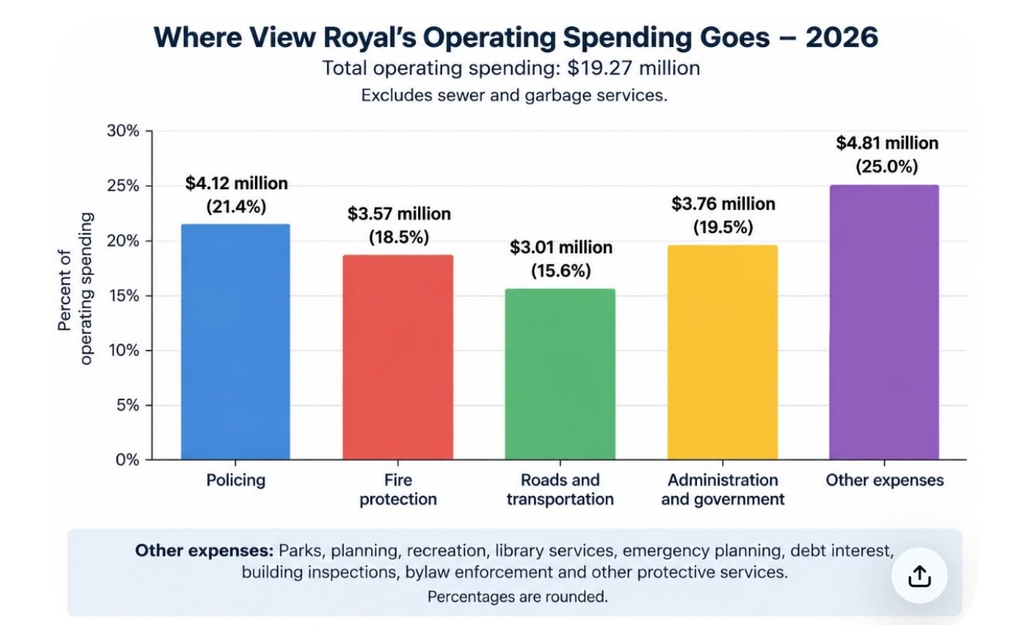
Where do your View Royal property tax dollars go?
Use a simple chart showing spending on policing, fire protection, roads, administration and other services.
September 11, 2026
“What does the mayor actually control?”
The mayor leads View Royal’s Council, but most decisions require a Council vote—and many services are controlled by other governments. Council sets municipal policy and budgets; the Chief Administrative Officer manages staff and daily operations. View Royal’s governance responsibilities
Here is how responsibilities divide:
Government or body
Main responsibilities affecting View Royal residents
What the mayor can do
Town of View Royal
Municipal taxes and spending; local roads, sidewalks and drainage; municipal parks; fire protection; garbage and food-waste collection; local sewer collection; bylaws, planning and development approvals within provincial rules
Propose priorities, question spending, vote and build Council support. Implementation belongs to staff under authorized policies and budgets.
Capital Regional District (CRD)
Drinking water; regional wastewater treatment; regional parks such as Thetis Lake; solid-waste management and Hartland landfill; regional planning, transportation coordination and some affordable housing
Advocate for View Royal and participate through regional governance. View Royal cannot unilaterally direct CRD decisions.
Province of B.C.
Health care, hospitals and provincial ambulance services; education through school boards; provincial highways; tenancy law; municipal powers and mandatory housing rules
Advocate, negotiate and seek funding. The mayor cannot direct hospital staffing, school operations or provincial highway projects.
Federal government
Criminal law, national defence, immigration, banking, international affairs and national programs such as Employment Insurance; funding partnerships for infrastructure and housing
Work with the MP and federal agencies, advocate for policy changes and seek funding. Federal decisions remain with federal authorities.
BC Transit and the Victoria Regional Transit Commission
Regional bus operations, routes, service levels and fares
Advocate for improvements and support local infrastructure such as bus stops and transit-priority measures. The mayor cannot independently order more buses or change fares.
Sources: View Royal services, CRD services, CRD transportation, government responsibilities, Transit Commission responsibilities.
Several issues cross these boundaries:
- Property taxes: Council sets the municipal portion. The Town also collects taxes for other authorities, including schools, the CRD and transit. Receiving one tax bill does not mean Council controls every charge. View Royal tax explanation
- Housing: View Royal controls local planning and zoning within provincial requirements. Council has meaningful choices, but cannot simply disregard provincially mandated housing permissions. B.C. zoning rules
- Water and sewer: CRD supplies View Royal’s drinking water. The Town manages its local sewer system, while CRD provides regional wastewater treatment. Town utilities, CRD treatment
- Policing: View Royal funds local policing through the West Shore RCMP arrangement. Police operations, provincial administration of justice and federal criminal law have separate responsibilities; the mayor does not decide individual investigations or court outcomes. View Royal services, Canada’s division of powers
A useful test for any mayoral promise is: Can Council deliver this directly, does it require a partnership, or is the mayor promising to advocate to another decision-maker?